
 C12 Projects
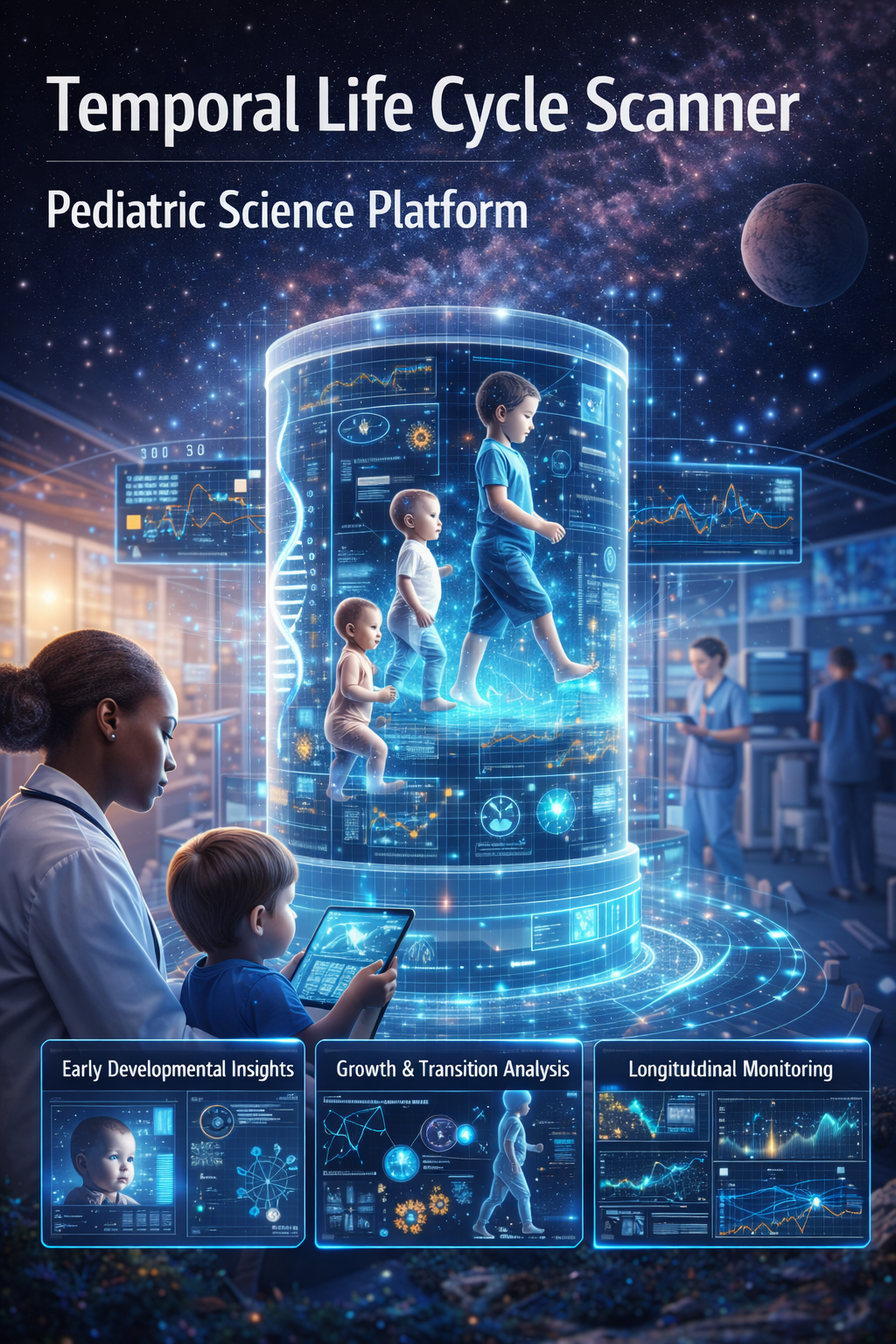
 Temporal Life Cycle Scanner is an advanced pediatric science platform designed to understand, monitor, and interpret biological development across time. It is built on a fundamental principle of pediatric medicine: childhood health cannot be evaluated at a single moment, but must be understood as a continuous developmental process.
Rather than focusing solely on static clinical measurements, Temporal Life Cycle Scanner analyzes growth trajectories, biological rhythms, and developmental transitions over time. This temporal approach enables a deeper understanding of how children grow, adapt, and mature, capturing patterns that are invisible to snapshot-based diagnostics.
One of the core strengths of Temporal Life Cycle Scanner is early detection. By continuously observing developmental signals, the system is able to identify early indicators of developmental delay, atypical growth trajectories, and subtle biological deviations long before they manifest as clinically evident conditions. This allows clinicians and researchers to intervene earlier, when outcomes can be most positively influenced.
Designed for real-world clinical adoption, Temporal Life Cycle Scanner is non-invasive and fully compatible with standard pediatric care pathways. It can be integrated into neonatal units, general pediatric practice, and clinical research environments without disrupting existing workflows. Its adaptability makes it suitable for routine monitoring as well as advanced longitudinal studies.
From a scientific perspective, Temporal Life Cycle Scanner represents a significant advancement in developmental biology and pediatric research. By introducing time as a primary analytical dimension, the platform aligns with the most modern approaches to life sciences, enabling more precise modeling of human development and variability.
Temporal Life Cycle Scanner establishes a new foundation for pediatric science, transforming developmental monitoring from isolated observations into a coherent, time-aware understanding of life’s earliest and most critical stages.